There is a text in the Pali Canon’s extended family that almost nobody in the West has heard of. It is called the Hatthavanagallavihāravaṃso — the Chronicle of the Hatthavanagalla Monastery — and it tells one of the most extraordinary legends in all of Buddhist literature.
A king gives away his own head.
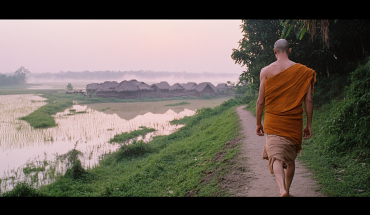
Not in a Jātaka tale. Not in a previous life. In this life, in recorded history, in a century and a place we can identify. King Sirisaṅghabodhi of Anurādhapura, who reigned for approximately two years in the middle of the third century CE, fled his throne rather than cause bloodshed, wandered into the forests of Sri Lanka’s wet zone, and when a bounty was placed on his head — literally — he pulled it from his own neck by the power of his spiritual determination and placed it in a stranger’s hands.
The stranger took it to the usurper. The head floated in the air and spoke.
A Text Between Two Translations
The Hatthavanagallavihāravaṃso was composed in the thirteenth century, probably under the patronage of King Parākkamabāhu II of Dambadeniya, though it preserves a narrative core from the third century that is corroborated by the Mahāvaṃsa (Chapter 36). It belongs to the vihāravaṃsa sub-genre — monastery chronicles that tell the history of a single institution through the lives of the kings who built it.
In 1866, James d’Alwis — a Ceylonese advocate of the Supreme Court and Member of the Royal Asiatic Society — published the first English translation: The Attanagalu-Vansa, or the History of the Temple of Attanagalla (Colombo: Williams and Norgate). D’Alwis was a remarkable scholar. His extensive annotations include local geographical identifications, inscriptional evidence, Mahāvaṃsa cross-references, and a pioneering comparative analysis of Buddhist self-sacrifice versus Christian martyrdom. He even visited the monastery site twice — around 1844 and again in 1866 — and left detailed measurements of the buildings, noting with alarm that over a hundred granite pillars had been reduced to sixteen in just twenty years.
But d’Alwis’s translation belongs to 1866. It tracks the Pali’s compound structure in formal Victorian English, producing sentences that are accurate but nearly impenetrable to a modern reader. And the book itself — published in a small colonial-era print run — has been effectively unavailable for over a century, surviving only in digitized library copies.
No modern translation has appeared since. A gap of one hundred and sixty years.
What the Chronicle Contains
The text is structured in eleven pariccheda (chapters), telling the story from beginning to end:
A prince is born near the sacred mountain of Mahiyaṅgaṇa, in a region called Maṇibheda — “Jewel-Cleft” — famous for its gem mines. His father, alarmed by a prophecy that the child will become sole ruler of the island, entrusts the infant to the Buddhist saṅgha and to the deity of the Bodhi Tree. The child is named Saṅghabodhi — “Awakening of the Community.” His father dies when he is seven. His uncle, a monk, raises him.
The uncle delivers a discourse that is the theological heart of the chronicle — a fifteen-paragraph warning about the dangers of youth, wealth, beauty, and power, illustrated by the famous five-animal simile: the moth destroyed by sight, the deer by sound, the bee by smell, the fish by taste, the elephant by touch. Each creature falls through bondage to a single sense. How much worse for the person who indulges all five?
Three childhood friends enter Anurādhapura together. A blind seer, sitting on the causeway of Tissawewa, hears their footsteps and declares: “All three will become lords of the island.” One becomes an operator. One becomes a schemer. And one — Saṅghabodhi — wants nothing to do with power. He sweeps the grounds of the Great Stupa and cares for the sick.
Power finds him anyway. When the throne falls vacant, the people and the saṅgha beg him to accept it. He refuses — and delivers one of the most brilliant anti-political speeches in Buddhist literature, comparing royal glory to a camphor-lamp (“the brighter it shines, the more soot it produces”) and systematically cataloging how courtiers rename every vice as a virtue: adultery becomes “sophistication,” hunting becomes “exercise,” drinking becomes “elegance.” The passage anticipates Orwell by seventeen centuries.
The saṅgha overrules him with a parable: a leech at the nipple draws only blood, but an infant draws milk. A fool-king produces only bad karma. A wise king uses the platform of power for merit. “You are such a person,” they tell him. “Do the kingship first. Ordain later.”
He accepts. He reigns. He breaks a drought by lying in the courtyard of the Great Stupa until the floodwaters lift him. He ends a plague by negotiating with a demon. He defeats bandits by staging fake executions — burning corpses from the charnel ground while secretly releasing the prisoners with money and a warning. He keeps the precepts. He keeps the water-strainer.
And then the schemer — Goṭhābhaya, the third childhood friend — marches on the capital with a rebel army. Saṅghabodhi does not fight. He takes his water-strainer, slips out through the south gate alone, and walks into the forest.
The rest you know.
The Monastery Still Stands
The chronicle does not end with the head. It ends with buildings. Goṭhābhaya, stricken with remorse, builds a circular relic temple at the spot where Saṅghabodhi died. Later kings restore and expand it. Parākkamabāhu II builds an octagonal Buddha-shrine — the first of its kind on the island — with a stone Buddha inside so lifelike that the chronicle says it seemed to breathe.
The last verse of the chronicle is not a lament. It is an invitation:
Whether by restoration of what has been damaged,
or by new construction,
or by the gift of fields and other endowments —
whoever in the future cares for this monastery,
let their names also be inscribed here.
The text ends by asking to be continued. The monastery at Attanagalla still exists. The ruins are still there.
A New Translation
The King Who Gave His Head: The Chronicle of the Hatthavanagalla Monastery presents the first modern English translation of this text — 160 years after d’Alwis. The translation is in plain, modern English: no Pali in the main text, no Victorian compound-tracking, no ornate literary register. The full Pali text, philological commentary, and 160 years of scholarly discussion (including extensive references to d’Alwis’s invaluable 1866 annotations) appear in the endnotes, where scholars can find them and general readers won’t trip over them.
Part I of the book — five chapters titled “The World of the Chronicle” — reconstructs the civilization that produced this text: the sacred city of Anurādhapura with its three rival monasteries and its stupas taller than anything in the Roman Empire; the “tank civilization” of the dry zone, with its bisokoṭuwa valve pits and cascading irrigation systems; the extraordinary Pali chronicle tradition that produced the Mahāvaṃsa and its satellites; and the specific political and theological context of Sirisaṅghabodhi’s brief, devastating reign.
Part II is the chronicle itself — every verse, every prose paragraph, all eleven pariccheda — translated into the kind of English that sounds like someone talking to you, because that is what a good translation should sound like.
The book is available now on Amazon in paperback and Kindle editions.
Why This Story Matters
King Sirisaṅghabodhi tested Buddhist ethics to destruction. He proved — and the Mahāvaṃsa’s own chapter-ending reflection acknowledges — that a king who fully embodies Buddhist virtue cannot hold power. His reign lasted two years. The warrior-king Duṭṭhagāmaṇī, who carried a relic of the Buddha in his spear and was consoled by arahants that the thousands he killed were “only one and a half people,” reigned for twenty-four. The Theravāda tradition preserved both stories, recognizing the inescapable tension between power and virtue without ever resolving it.
Sovereignty, the Mahāvaṃsa concludes, is “sweet food mixed with poison.”
Sirisaṅghabodhi took the poison. And gave away the food. And the head. And seventeen centuries later, we are still telling the story — because a thirteenth-century author, working from older sources by lamplight in a monastery in the western lowlands, wrote it down and asked that whoever comes after should add their name.
We are adding ours.