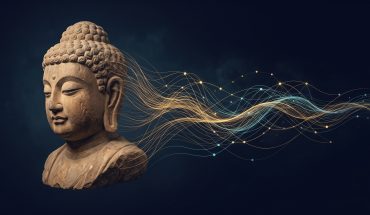
Artificial intelligence, the Pāli canon, and the habits that shape experience.
An unkind sentence can occupy the mind long after its speaker has gone. We remember the emphasis on one word and find three earlier occasions that now seem to explain it, then compose a reply and conduct the conversation again, in the hope of finding the words that would have settled it. Considerable intelligence may go into this work. By midnight we have understood every possible implication of the sentence except what our continued attention to it is doing to us.
Natalie Wolchover’s recent Quanta essay, “Is ‘Attention’ the Essence of Intelligence?”, follows the development of the attention mechanisms behind modern language models and asks whether their success reveals something fundamental about intelligence, including our own. Wolchover leaves room for doubt: human thought extends beyond language, and the brain’s way of accomplishing these tasks remains uncertain.
For a reader of the Pāli discourses, the question has an unexpected familiarity. The Aṅguttara Nikāya contains this sentence:
Manasikārasambhavā sabbe dhammā.
All phenomena have attention as their source.
That is AN 10.58, the Mūlaka Sutta. The same passage assigns other roles to collectedness, mindfulness, and wisdom, and gives liberation the place of sāra—the heartwood, the valuable substance—before ending the list with nibbāna.
Once attention has brought something into play, what happens to the mind that attends? A person may become more perceptive about an insult and more captive to it with every fresh observation, even as the growing detail of the account makes them feel they are getting closer to the truth. Buddhist training takes that possibility seriously. The quality of attention includes its consequences.
What an attention mechanism does
The engineering problem was initially translation. In their 2014 paper, Dzmitry Bahdanau, Kyunghyun Cho, and Yoshua Bengio replaced a restrictive arrangement in which a source sentence had to be compressed into one fixed-length vector. Their decoder could instead draw selectively on representations of different source positions as it produced the translation. The information relevant to the next word could change from step to step. Bahdanau, Cho, and Bengio
The 2017 transformer developed this approach. Representations produce queries, keys, and values, and the scores between queries and keys determine how much the corresponding values contribute to an updated representation—a way of allowing different parts of the available context to matter by different amounts. Several attention heads perform such operations in parallel. For text generation, a causal mask prevents access to future tokens. The paper’s title, Attention Is All You Need, announces the replacement of recurrence and convolution in the proposed architecture. Attention still works alongside other components, including feed-forward networks and positional information. Vaswani and colleagues, §§3.1–3.5
This mathematical use of “attention” describes how information contributes to a computation. The comparison with Buddhism becomes useful at the level of a problem: what we do with an object depends on which relations we make relevant. Whether the mechanisms are alike is a separate empirical question; the Pāli discourses supply a vocabulary for examining what our own attending involves.
The different jobs hidden inside attention
Manasikāra is the closest starting point. It means attending, bringing something to mind, directing the mind toward it. When SN 12.2 defines nāma, it places attention alongside feeling, perception, intention, and contact, so that the act of attending belongs among the conditions of experience that the practitioner is being asked to understand.
It would lose much of the canon’s precision to translate all the neighbouring terms as attention too:
| Pāli term | Function relevant here | A canonical point of reference |
|---|---|---|
| Manasikāra | Attending to something in a particular way | MN 2 distinguishes wise and unwise attending. |
| Sati | Mindfulness and recollection; retaining what needs to be kept in mind | SN 48.10 joins remembering with the establishments of mindfulness. |
| Sampajañña | Clear comprehension of one’s activity | MN 10 applies it to walking, looking, eating, and other daily actions. |
| Samādhi | The mind’s collectedness or unification | MN 44 defines it through cittassa ekaggatā, the mind’s unification. |
| Paññā | Discernment, developed into understanding that ends suffering | SN 48.10 connects it with arising and passing away and the four noble truths. |
These functions overlap. MN 43 explicitly describes feeling, perception, and consciousness as intertwined. The distinct definitions help us examine aspects of a single experience.
The remembering in sati is particularly easy to miss. SN 48.10 describes someone who remembers what was done and said long ago, then proceeds to contemplation of body, feelings, mind, and mental phenomena. The memory sense belongs to the text itself. During practice, the mind can become so absorbed in a thought that it forgets the thought was supposed to be observed; remembering the undertaking helps keep the experience available for examination while its content is trying to carry us elsewhere.
AN 10.58 keeps these functions distinct in its own compressed language:
Samādhippamukhā sabbe dhammā, satādhipateyyā sabbe dhammā, paññuttarā sabbe dhammā, vimuttisārā sabbe dhammā.
All phenomena have collectedness at their head, mindfulness as their governing power, wisdom above them, and liberation as their heartwood.
The breadth of sabbe dhammā, “all phenomena,” requires care. The commentary on the related AN 8.83 understands it here through the five aggregates; read in that setting, the list moves between the conditions of ordinary experience and the cultivation that culminates in release.1 Its terms name roots, sources, governing powers, and fulfilments. Attention has an essential place in this account, while wisdom and liberation answer further questions about the life of the mind.
How a mind can attend itself into trouble
The opening of MN 2, the Sabbāsava Sutta, makes the distinction explicit:
Ayoniso, bhikkhave, manasikaroto anuppannā ceva āsavā uppajjanti, uppannā ca āsavā pavaḍḍhanti.
For one attending unwisely, monks, unarisen taints arise, and taints already arisen increase.
Āsava is a technical term, conventionally rendered “taint,” “influx,” or “fermentation.” The discourse identifies taints connected with sensuality, becoming, and ignorance. They concern the mind’s bondage and can be active in experiences a person finds pleasant.
The opposite mode is yoniso manasikāra, wise or appropriate attention. The adverb yoniso carries the sense of attending properly or with regard to origins; its force here has to be learned from the examples.2
The untrained person in MN 2 attends to what should not receive that attention and neglects what should. The criterion is what follows: do the taints arise and grow, or are they prevented and abandoned?
One of the examples is a chain of questions about the self:
Ahaṃ nu khosmi? No nu khosmi? Kiṃ nu khosmi? Kathaṃ nu khosmi?
Do I exist? Do I not exist? What am I? How am I?
The passage also ranges over past and future existence. Such questioning can produce a settled view, including either atthi me attā, “I have a self,” or natthi me attā, “I have no self.” Both occur in its list of entangling positions.
That second possibility should trouble an overly quick Buddhist answer. A person can adopt the proposition that there is no self while continuing to organize experience around the need to secure a position about themselves, so that even this conclusion becomes something to insist upon and defend. MN 2 tests the way the inquiry operates. The language of the answer can change while that habit persists.
The wise alternative is stated in equally definite language: the practitioner attends to suffering, its arising, its cessation, and the way to that cessation. The four noble truths become a mode of inquiry, a way of approaching an experience in terms of conditions that can be understood and a task that can be undertaken, with the prospect of bringing the suffering to an end.
Applied to the unkind sentence, this would include recognizing the hurt and examining how recollection becomes resentment. The practical issue may still need an answer, and the other person may have behaved badly, but rehearsing their offence for the twentieth time and understanding the conditions that sustain one’s anger are different activities. Both can be absorbing. Their consequences are part of what the discourse asks us to examine.
What repeated attention feeds
In SN 46.51, the Buddha calls this relation āhāra, food. The discourse examines what feeds the five hindrances and what feeds the seven factors of awakening. Concerning ill will, it says:
Atthi, bhikkhave, paṭighanimittaṃ. Tattha ayonisomanasikārabahulīkāro…
There is, monks, a feature that provokes aversion. Repeated unwise attention to it…
That is the food for ill will to arise and, once arisen, to grow. The compound ayoniso-manasikāra-bahulīkāra brings together unwise attending and the act of making much of it, practising it repeatedly. The sentence concerns a habit of engagement with a feature of experience.
An angry person can be observant. They may recall genuine faults and detect real inconsistencies, yet the search for another fault can become the activity through which anger maintains itself, because every discovery gives the next search a reason to begin. In the language of the discourse, the hindrance is being fed.
The person in bed replaying a quarrel may have little attention left for anything else. What requires examination is the recurring manner of taking up the object.
The same discourse identifies what deprives ill will of food:
Atthi, bhikkhave, mettācetovimutti. Tattha yonisomanasikārabahulīkāro…
There is, monks, liberation of mind through goodwill. Repeated wise attention to it…
The intervention changes what the mind cultivates. Goodwill requires relinquishing the wish for another person’s suffering. That can alter an encounter even when the offending behaviour calls for a firm response.
There is a further distinction between attending through ill will and attending to ill will as something present. MN 10, the Satipaṭṭhāna Sutta, explicitly requires the latter:
Santaṃ vā ajjhattaṃ byāpādaṃ ‘atthi me ajjhattaṃ byāpādo’ti pajānāti…
When ill will is present within, one knows: “There is ill will within me.”
The instructions continue into knowing how it arises, how it is abandoned, and how its future arising is prevented. When anger is recognized in this way, it becomes possible to examine a process that had been sustained by our own attending while we were occupied with finding its cause entirely in the other person’s faults.
These passages concern both the object and the manner of attention. Sometimes a different theme is useful, as with goodwill. Sometimes the existing state itself needs to be understood.
Two discourses later, in SN 46.53, the Buddha distinguishes a sluggish mind from an agitated one. When the mind is sluggish, developing tranquillity, concentration, and equanimity is untimely; investigation, energy, and joy help rouse it. When it is agitated, the prescription reverses. The image is a fire: a failing flame needs dry fuel and air, while a blaze can be subdued with damp fuel and earth.
Mindfulness is said to be applicable throughout. In practice, that means keeping enough of the situation in view to recognize when a valued quality such as equanimity is being cultivated at the wrong time, just as one has to know the state of the fire before adding fuel. An instruction to “be more attentive” has left much of this practical intelligence unspecified.
When thinking begins to pursue the thinker
The Madhupiṇḍika Sutta, MN 18, examines how an encounter develops into mental proliferation. Mahākaccāna explains the sequence beginning with a sense faculty and its object, the corresponding consciousness, and contact. Contact conditions feeling. Then comes a compact series:
Yaṃ vedeti taṃ sañjānāti, yaṃ sañjānāti taṃ vitakketi, yaṃ vitakketi taṃ papañceti.
What one feels, one perceives; what one perceives, one thinks about; what one thinks about, one proliferates upon.
Vedanā, feeling, concerns the pleasant, painful, or neutral tone of experience. Saññā recognizes or identifies. Vitakka takes something up in thought. Papañca names a further elaboration whose oppressive character becomes clear in what follows. The difficult compound papañcasaññāsaṅkhā can be rendered “perceptions and designations born of proliferation,” though its precise analysis remains disputed.3
The grammar then changes. The person becomes the object of the verb: these elaborations samudācaranti, assail or beset, the person. Their reach extends across past, future, and present. Someone who had heard a single sentence now has an entire history of being slighted pressing upon them, together with anticipated confrontations that have yet to occur and replies to accusations nobody has made.
The discourse concerns a process that can be interrupted. Its sequence should also be read alongside MN 43’s account of intertwined mental functions: it provides a way of analysing the experience, rather than a measurement of separate processing stages in the brain.
What makes the example recognizable is the expanding supply of relevance. A memory becomes evidence for an interpretation, the interpretation makes another memory salient, and the future exchange is imagined in terms established by this selected past, until the mind has supplied itself with enough material to continue for hours. The body was trying to sleep.
There is an analogy here with the way generated text can enter the context from which further text is produced. In the human case described by MN 18, feeling and attachment give this continuing elaboration its practical urgency. The account concerns the suffering of being caught in it.
It also makes room for a practical interruption. A thought can become an object of investigation while it is occurring. Its content remains available, but attention can now include its feeling tone, its recurrence, and the demand to act on it. That is an extension of what is being known. The apparent urgency of finishing the internal argument can itself be examined.
The inclination left by a thought
MN 19, the Dvedhāvitakka Sutta, adds duration to this account. Recalling his practice before awakening, the Buddha describes dividing thoughts into two groups. Sensual desire, ill will, and cruelty belong to one; renunciation, goodwill, and harmlessness to the other.
The division rests on consequences. A thought is examined for the harm it brings to oneself and others, its obstruction of wisdom, and its relation to nibbāna. The pleasantness of the experience would make a poor substitute for this examination: revenge can be enjoyable to imagine, while recognizing one’s own cruelty may be painful enough to tempt the mind away from a useful discovery.
Then comes the general observation:
Yaññadeva, bhikkhave, bhikkhu bahulamanuvitakketi anuvicāreti, tathā tathā nati hoti cetaso.
Whatever a monk frequently thinks about and examines, toward that the mind comes to incline.
Nati is an inclination, a leaning. The next sentences explain it concretely: repeatedly dwelling on sensual thoughts inclines the mind toward them; repeatedly dwelling on harmlessness inclines it toward harmlessness. A thought leaves something behind beyond the conclusion reached on this particular occasion, because the act of returning to it has also been practice in a way of thinking that the mind can more readily take up again.
The evening spent composing an angry reply therefore has two possible products: a polished reply, and practice at resentment. The second may outlast the first. We might judge the reply accurate and ingenious while overlooking what its author has spent the evening rehearsing.
Machine learning makes the comparison tempting, but two timescales must remain distinct. Learning during model training changes parameters. Responding to examples within a prompt can change performance without such updates: the GPT-3 experiments explicitly evaluated this capacity without gradient updates during the task. Brown and colleagues Repeatedly typing something to a model is therefore not, by itself, evidence that its underlying parameters have been retrained. The Buddhist claim about habitual thought belongs to its own account of cultivation.
While pursuing the thought in front of us, what inclination are we rehearsing?
MN 19 carries the training further. Even beneficial thinking, prolonged too far, can tire the body and disturb the mind, so the Buddha describes settling and unifying it at the point where continuing an otherwise harmless activity would interfere with collectedness. The content of thought has been improved, and a further change in activity becomes appropriate.
When words have done their work
The relation between language and thought is also a question within the modern research Wolchover discusses. In their 2024 Nature perspective, Evelina Fedorenko, Steven Piantadosi, and Edward Gibson argue from neurological and other evidence that complex thought does not invariably depend on the brain’s language network. They treat language as a powerful means of communication while distinguishing that role from the claim that linguistic processing is necessary for thought. Fedorenko, Piantadosi, and Gibson
One of the empirical studies they discuss examined three men with severe acquired grammatical impairments. All retained substantial mathematical capacities, including operations that required sensitivity to the structure of bracketed expressions. The participants had learned before their injuries, so this small study concerns adult performance; the developmental role of language is a further question. Its significance lies in the dissociation: severe impairment of linguistic grammar could coexist with structured calculation. Varley and colleagues
The Buddhist material approaches the relation through contemplative training. In MN 44, the nun Dhammadinnā explains why vitakka and vicāra are called vacīsaṅkhāra, the preparation for speech:
Pubbe kho, āvuso visākha, vitakketvā vicāretvā pacchā vācaṃ bhindati, tasmā vitakkavicārā vacīsaṅkhāro.
First, friend Visākha, having thought and examined, one afterwards breaks into speech; that is why thought and examination are the preparation for speech.
The temporal words are pubbe, first, and pacchā, afterwards: the activity that prepares an utterance precedes the utterance. In the same exchange, perception and feeling receive a separate classification as cittasaṅkhāra, the mental preparation.4
The jhāna account in MN 19 makes the distinction experiential. In the second jhāna, vitakka and vicāra have subsided, yet the description retains joy, pleasure, and unification; in the third it explicitly includes being sato ca sampajāno, mindful and clearly comprehending. The contemplative account allows important forms of awareness to remain when the thinking associated with speech has settled.
The neurological findings concern capacities retained after injury; the jhāna passages describe contemplative attainments. Their modest point of contact is that fluent linguistic activity need not exhaust what a mind can do. Within the canonical account, settling one mental activity can allow other capacities to continue more steadily.
Words can have a useful place in that cultivation. MN 2 gives the four truths as articulated contents of wise attention. MN 10 repeatedly expresses knowing through a short quotation: there is ill will present, a feeling is pleasant, a breath is long. Such formulations can orient an inquiry or help a practitioner recognize what is happening. The quotative grammar itself does not prove that every practitioner must silently recite a label.5
The role of a phrase has to be judged in the exercise. Naming anger may help someone recognize it before speaking, but the same phrase can become another sentence repeated while the conditions of the anger go unexamined and the urge to say something hurtful continues to gather strength. As practice develops, recognition can become less dependent on an accompanying commentary. MN 19 supplies a reason to care about that transition: continuing to think can eventually interfere with the collectedness the thought was meant to support.
These discourses are full of questioning, reasoning, and careful correction. They ask us to learn when those activities help, what they prepare, and when their continued use has become unnecessary.
The purpose retained in the practice
The comparison with AI brings a distinction into focus that is easy to overlook in discussions of meditation. Competence at carrying out a task leaves open the choice of task and the effects of carrying it out. The canon’s account of wisdom includes understanding those effects, especially the conditions of suffering and their cessation. That is a more specific concern than intelligence understood as success across a range of problems.
In MN 117, noble right concentration is described as unification of mind furnished with the other seven factors of the path, including right speech, action, and livelihood. The discourse places collectedness within a way of living, so that assessing it requires attention to how someone acts and what they intend, as well as to their ability to remain focused on an object.
MN 43 makes a further distinction between wisdom and consciousness. It describes them as intertwined, then assigns them different tasks:
Paññā bhāvetabbā, viññāṇaṃ pariññeyyaṃ.
Wisdom is to be developed; consciousness is to be fully understood.
The verbal endings make these instructions about what to do. Consciousness, the very knowing through which a world is encountered, enters the field of investigation, and the practitioner can examine how it arises and what it depends on, rather than taking it for granted while concentrating entirely on the things known. In the quarrel, this includes recognizing the remembered voice as a present mental event: something happening now, with conditions, even though its content refers to yesterday.
The purpose is also more demanding than feeling calm. SN 38.1 defines nibbāna through rāgakkhayo dosakkhayo mohakkhayo: the ending of passion, hatred, and delusion. A temporary reduction in agitation can assist that work; it is not sufficient evidence that the work is finished.
Applied to artificial intelligence, this distinction invites us to ask what a capacity is used for and what follows from its use. It does not authorize claims that a model suffers, possesses the canonical mental factors, or can attain liberation. Those would require arguments and evidence beyond a resemblance between descriptions of information processing. A Buddhist assessment of a system’s effects on people can proceed without settling those questions.
For the person practising, the problem is closer. The ability to explain attention can itself become another accomplishment to defend. In AN 9.14, Sāriputta questions Samiddhi about the conditions and fulfilment of thought. The answers again lead through mindfulness and wisdom to liberation. Sāriputta praises the answers, then adds tena ca mā maññī: do not conceive conceit on that account.6 Correctly describing the mind leaves the use of that knowledge open.
The quarrel remembered at midnight offers a small occasion to put it to use. The sentence returns. There is its remembered sound, the unpleasant feeling, the wish to reply. MN 10’s instruction permits recognition of the ill will that is present; its further instructions invite understanding of what brings it up and what allows it to cease. The remembered words are now part of a larger field of inquiry.
It may become possible to distinguish the conversation that needs to happen tomorrow from the one the mind keeps conducting tonight. Goodwill can be attempted without surrendering a necessary boundary. The body can be allowed to settle. If the thought returns, its return too can be known, without treating it as a command to finish the speech.
There is still something to understand about the other person. There is also this movement of the mind, available now, before the next reply.
Texts and translation notes
Pāli passages were checked in the local Chaṭṭha Saṅgāyana text. Translations of those passages are made for this essay; links identify the discourses and provide access to other editions and translations. The comparison is interpretive, not a claim of historical influence between Buddhist analysis and AI engineering.
-
AN 10.58, CST §58; compare AN 8.83. The Manorathapūraṇī on AN 8.83 glosses sabbe dhammā as pañcakkhandhā, the five aggregates. It assigns the first four descriptions to the mundane and the remaining descriptions to a mixture of mundane and supramundane. The commentary on AN 10.58 refers back to the earlier explanations and discusses its additional nibbāna clauses. This is a later commentarial interpretation, not an extra sentence in the sutta. The source record preserves the distinction. Chanda, the “desire” at the beginning of the list, should not automatically be equated with the craving, taṇhā, to be abandoned.↩︎
-
MN 2, CST §§15–21. “Wise,” “appropriate,” and “thorough” are common attempts to express the force of yoniso in this setting. The contrast is with ayoniso, and the discourse’s examples constrain the interpretation: the rise and abandonment of the taints, the proliferation of self-views, and attention in terms of the four truths. The etymological association with yoni, source or origin, does not make “thinking about causes” an adequate definition in every occurrence.↩︎
-
MN 18, CST §204. The gloss “perceptions and designations born of proliferation” is interpretive; the components and relation within papañcasaññāsaṅkhā have received different analyses. The argument here rests on the undisputed direction of the clause: the plural subject acts upon purisaṃ, the person, with regard to objects of past, future, and present. The conversation in bed is a modern illustration, not a canonical example or a proposed translation of the compound.↩︎
-
MN 44, CST §463; MN 19, CST §§209–211. “Thought and examination” preserves the connection with ordinary thinking and the preparation of speech. Translations emphasizing directing and sustaining the mind are common in accounts of jhāna. The exact experiential range of vitakka-vicāra is debated. Neither rendering licenses equating every instance with a fully verbal sentence, or identifying its subsiding with the disappearance of all cognition. MN 44 separately discusses the cessation of perception and feeling; that attainment must not be conflated with second jhāna.↩︎
-
The short quotations are a feature of Pāli ways of reporting the contents of knowing. They can support an investigation of mental formulation in practice, but iti is not by itself an instruction to recite. This distinction also matters for the earlier Theravadin research on noting: a practice interpretation needs evidence beyond the presence of a quotative particle.↩︎
-
AN 9.14, CST §14. Mā maññī is a prohibition on conceiving or construing; the context concerns taking the achievement as a basis for self-estimation. The Manorathapūraṇī explicitly glosses the warning against pride in having answered the chief disciple’s questions. The English rendering used here follows that contextual interpretation.↩︎