
 The Theravada Tipitaka Press has recently released a new book in their series of bilingual Pali primers. In case you are unfamiliar with the concept: In South-East Asia, traditionally, to learn the “sacred” language of the Buddha, beginning students would be encouraged to read the Buddha’s words in a text that is interspersed with the original Pali language. This “sentence-by-sentence” bilingual reading style (see image on the right) was considered to prime your mind to really let the source language, in this case Pali, – its syntax and semantics – sink into the reader’s mind.
Even nowadays, if you happen to visit Sri Lanka and enter any old countryside temple library (which, sadly, can be in a very neglected state of affairs), you will find volumes upon volumes of beautifully leather-bound Pali-Sinhala “sannaya” textbooks that were in use during the early 20th century, in the heyday of the Sri Lankan Buddhist anti-Protestant revival. How is this “language paraphrasing” supposed to work exactly? And why does it facilitate learning a foreign language?
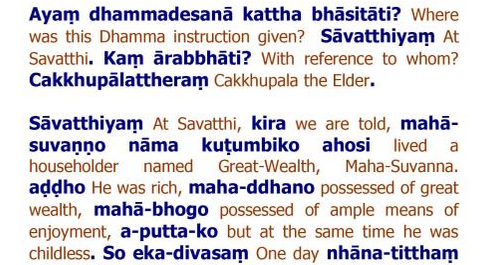
Ultimate Dhammapada, a bilingual Pali primer
If you think of the brain as one giant neural network, then aligning the source and target language right next to each other does seem like a safe way to study and quickly digest a foreign language. You train your existing “network” of thoughts in your native language with the new foreign language that you are trying to pick up. The Theravada Tipitaka Press has tried to re-establish interest in this kind of Pali learning and came out in recent years with a few books from the Pali canon that are both in English and Pali and follow a similar pattern.
The latest book in their series is called “The Ultimate Dhammapada” – it’s just the first volume of a whole series that (hopefully one day) will culminate in the most complete Dhammapada translation ever undertaken. Volume one contains the first 3 verses of the Dhammapada, including the Dhammapada commentary by Buddhaghosa, in a beautiful Pali-English paraphrased setup.
I believe this is their first tackling of a commentarial book (as the Dhammapada commentary or atthakatha was written by Buddhaghosa in 500 CE), and as such it’s especially interesting if you are trying to learn the commentarial style Pali language, which is quite different from the language of the suttas. Commentarial Pali (used in medieval times) is notoriously hard to learn and interpret correctly, but of course, as there is such a massive secondary and tertiary canon of commentarial literature in Pali and some of it quite old (300/200 BC), it might be worth the effort.
Even if that’s not your goal, reading the Dhammapada side by side with the English translation, including the “fun” commentarial stories explaining why the Buddha delivered these verses, is a rewarding meditative experience.