In studying an old meditation manual — the Dharmatrāta Dhyāna Sūtra, a fifth-century Chinese translation of a Sarvāstivāda handbook carried out of Kashmir (before that Buddhist world was destroyed) I came across visualization meditation, in particular the old idea of a “disc” (mandala). The disc brightens. It steadies into a radiance “like crystal,” arranged in tiers. My first reflex, I confess, was the modern one: here comes the weird stuff.
I went looking for where it came from. What I found is that vision-meditation — the disc, the inner light, the seen forms — is not a late esoteric graft at all. It is in the oldest layer of the canon, described in the plainest terms, and the Buddha is made to report it of himself. More than that: the ancients handled it with a caution and a precision that the modern versions have almost entirely lost. Let us have a closer look.
The Buddha’s own report
We find a first-person account by the Buddha, in a discourse the Pāli tradition calls the Upakkilesa Sutta, the “Imperfections” (MN 128). He is telling Anuruddha how he struggled before the awakening:
Obhāsañceva sañjānāmi dassanañca rūpānaṃ. So kho pana me obhāso nacirasseva antaradhāyati dassanañca rūpānaṃ.
“I perceive both a light and a vision of forms. But before long that light of mine vanishes, and the vision of forms with it.”
Inner light (obhāsa) and a seeing of forms (dassana rūpānaṃ) are treated as an ordinary — if hard-won — event of deep concentration. The Buddha does not admire the light. He troubleshoots it. “What is the cause,” he asks himself, “what the condition, that my light vanishes and the forms with it?” And he sets out to catch the culprit.
What he catches is a list — the eleven upakkilesa, the imperfections that dispel the light: doubt; inattention; sloth-and-torpor; a flush of fear; a rush of elation when the light first comes; a heaviness in the body; effort driven too hard; then effort gone too slack; a longing for the thing; a mind pulled toward the sheer variety of what appears; and, last, a straining, greedy over-scrutiny of the forms themselves. Each one, as he names it and drops it, the light returns and steadies a little more, until at last it holds.
The light is real. The light is unstable. And the light is diagnostic: when it dims or breaks, the fault is not in the light but in the mind, and the work is to find which fault and let it go. The meditator is not asked to produce a light and gaze at it. He is asked to read his own mind off the light, the way you read a fever off a thermometer.
The disc, before the Tantra
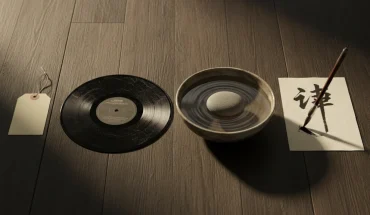
So much for the light. What about the disc — the maṇḍala that startled me in the manual? Here too the root is older and plainer than the reputation. The word maṇḍala means, first of all, simply a disc, a circle. And the oldest meditation that uses one is the practice of the kasiṇa. You take a plain round object — a disc of prepared earth, a bowl of water, a circle of colour — and you look. You look until the image can be held with the eyes closed; and then, as the mind settles, that held image gives way to a brighter, purer one that the tradition calls the paṭibhāga-nimitta, the “counterpart sign,” and describes as arising like a burnished mirror drawn from its case, or the moon stepping clear of cloud.
The commentarial handbooks call the prepared disc exactly what it is — a kasiṇa-maṇḍala, a kasiṇa-circle — and tell you to fix the earth-sign kasiṇamaṇḍalaṃ katvā, “having made a disc.” There it is: a maṇḍala, in the plainest sense, at the very heart of samatha practice — a disc of clay gazed at until it becomes a disc of light held in the mind. This is centuries before the consecrated, deity-filled maṇḍala of the later Tantra, and it owes that later diagram nothing. When my Kashmiri manual sets a disc of radiance before the meditator, it is not importing esoterica. It is elaborating the kasiṇa.
And it does not stand alone. The canon is full of this visual training if you look for it. There are the eight abhibhāyatana, the “bases of mastery,” in which the meditator sees external forms in each of four pure colours and learns to dominate them — the formula is always the same, and rather beautiful: forms “blue, of blue colour, of blue sheen — as the flax-flower is blue, or as fine Benares cloth burnished on both sides is blue,” and so for yellow, red, white. There is the bare ālokasaññā, the “perception of light,” which the Buddha prescribes to a drowsing Moggallāna as the specific antidote to sloth — attend to a light, “by day and by night alike,” until the sinking mind lifts. The old teachers had a whole visual gymnasium, and they used it with care.
Which brings us to the modern half
Here is where it gets, to me, genuinely surprising. Because the two things the Buddha says about the light in MN 128 — that it is real, and that it is diagnostic — are the two things the modern study of the mind has independently arrived at.
Take “real” first. In 2013 a team at Brown University — Jared Lindahl, Willoughby Britton and colleagues — did something researchers had oddly never bothered to do: they collected careful, first-person reports of light experiences from living Western meditators and set them beside the classical Buddhist descriptions. The practitioners reported the same two families the old manuals catalogue — discrete forms of light (points, discs, stars) and diffuse fields of brightness — phenomena, the authors noted drily, that are all over the Buddhist literature and almost entirely missing from the earlier scientific writing on meditation. Their proposed mechanism is sober and physical: deep concentrative practice is a form of sensory attenuation, close kin to the sensory deprivation studied in the lab, and both let the visual system’s own low-level activity surface into awareness as light and form. In other words, when you sit very still, eyes closed, in silence, attending to one thing, the din of the senses falls quiet and you begin to see the nervous system’s own faint working. The ancients, it turns out, were reporting accurately.
Now “diagnostic,” which is the part that matters for practice. When Mihály Csíkszentmihályi mapped the conditions of “flow” — the absorbed, effortless state of a musician or a climber at full stretch — he found that two of its preconditions were a clear goal and immediate feedback: the doer has to be able to tell, moment by moment, how the doing goes. That is precisely the office MN 128 gives to the light. Steady and bright, it reports a mind well-placed; dim, broken, or gone, it reports a fault to be found and dropped. The meditator reads his attention off the light as a climber reads the rock, and corrects in real time. What the manual calls a meditative sign, the psychologist calls a feedback channel.
There is even a fit at the level of mechanism, and it is worth a moment. The leading neural account of flow, Arne Dietrich’s “transient hypofrontality,” holds that in such states the brain’s executive centres — the seat of effortful self-monitoring and inner chatter — quiet down, and the sense of a striving, watching self recedes. Now set that beside the Buddha’s list of the eleven imperfections that dispel the light: over-driving effort, elation, longing, the anxious over-scrutiny of the forms. Every one of them is a mode of the striving, self-watching mind. In the old account the light steadied only when the grasping effort was released; the modern account would say the executive machinery had to stand down. Two vocabularies, seventeen centuries apart, circling one fact — the inner light comes clear when the self stops clutching at it. I do not know a cleaner example of the canon and the laboratory shaking hands.
A curiosity, freely offered
What follows is a curiosity of natural history. The old yogic traditions speak of a “third eye” in the middle of the brow and mean it, of course, as a figure. But it happens that vertebrates carry a literal light-sensitive organ deep in the brain — the pineal gland — and its story has lately been told with some precision. In lizards, in the tuatara, in lampreys, the pineal complex still breaks the surface as a small working “third eye” at the crown of the head, the parietal eye, complete with a simplified retina and its own light-sensing pigments. And a 2025 study argues that this single median eye is the elder structure — a relic of a sedentary, plankton-filtering sea-creature of some six hundred million years ago that had lost its paired eyes and kept one eye at the top of its head. On that telling our own two eyes were later rebuilt outward from the median organ, while the organ itself dwindled inward to become the pineal gland, known today for little more than running the sleep-clock by a light it can no longer directly see.
None of this touches the meditative light, which is a matter of the working visual cortex and not of any surviving eye. The two only rhyme, in the odd fact that the head has kept more than one way of answering to light. But it is a good rhyme, and I could not resist it.
Lessons learned
So — what does any of this do for a practitioner? Three things, I think.
First, it takes the fear out of the light. If a disc of brightness, or a field of it, or a floating form should arise as concentration deepens — and for some temperaments it will — it is not a sign of anything having gone wrong, nor of anything mystical having gone right. It is an ordinary event of a quieted visual system, well-attested from the Buddha’s own report to a Brown University questionnaire. You need neither chase it nor flee it.
Second, and more usefully, it tells you what the light is for. It is a gauge. The whole burden of MN 128 is that the light is a readout of the mind’s condition, and the practice is to keep the reading clean — to notice the doubt, the elation, the over-effort, the greedy staring, and to set each down. The meditator who falls in love with the light and gazes at it has, on the canon’s own terms, already made the eleventh mistake: atinijjhāyitatta, over-scrutiny of the forms. The instrument is not to be admired. It is to be read, and released.
Third — and this is the quiet thread that ties the ancient text to the modern data — the light rewards exactly the move the whole path rewards: letting the striving self stand down. It steadies when you stop clutching. Which is only what the breath teaches, and the body, and the mind’s own moods, when you watch them closely enough: that the grip is the problem, and the loosening is the way.
Guest post: The textual work above comes out of a book now in preparation — The Dharmatrāta Dhyāna Sūtra: A Himalayan Meditation Manual — and the Roots of Zen, the first readable English edition of the meditation handbook (T618) that Buddhabhadra carried from Kashmir to China in the early fifth century, and a companion to the recently completed Path of Practice (the Yogācārabhūmi of Saṅgharakṣa, T606). The appendix on visionary meditation, from which this post is drawn, sets the manual’s disc of light against its canonical ancestry and its modern echoes at greater length.
— Lucian Reade
References
Pāli cited from the Chaṭṭha Saṅgāyana Tipiṭaka (Vipassana Research Institute, Roman-script edition); CST file given where useful.
- MN 128, Upakkilesa Sutta (CST s0203m, Majjhima Uparipaṇṇāsa): obhāsañceva sañjānāmi dassanañca rūpānaṃ…, with the eleven upakkilesa that dispel the light and forms (doubt, inattention, sloth-and-torpor, fear, elation, unwieldiness, effort overdone and underdone, longing, perception of diversity, over-scrutiny of forms).
- The kasiṇa-maṇḍala and the paṭibhāga-nimitta: Visuddhimagga IV–V; the ten kasiṇas at DN 33 (Saṅgīti), MN 77, AN 10.25–26; the disc prepared kasiṇamaṇḍalaṃ katvā.
- The eight abhibhāyatana (bases of mastery), colour formula with the similes of the umā (flax) flower and double-burnished Benares cloth: MN 77; DN 16; AN 8.65; Vibhaṅga (CST abh01m, s0202m).
- Ālokasaññā (perception of light) as the antidote to sloth-and-torpor, “by day and by night alike”: AN 7.61 (Pacalā); commentarial gloss thinamiddhassa paṭipakkhe ālokanimitte saññā.
- Jared R. Lindahl, Christopher T. Kaplan, Evan M. Winget & Willoughby B. Britton, “A Phenomenology of Meditation-Induced Light Experiences: Traditional Buddhist and Neurobiological Perspectives,” Frontiers in Psychology 4 (2014): 973. Part of the Varieties of Contemplative Experience project.
- Mihály Csíkszentmihályi, Flow: The Psychology of Optimal Experience (New York, 1990) — challenge–skill balance, clear goals, immediate feedback.
- Arne Dietrich, “Functional Neuroanatomy of Altered States of Consciousness: The Transient Hypofrontality Hypothesis,” Consciousness and Cognition 12 (2003): 231–56.
- Dan-E. Nilsson et al., “Evolution of the Vertebrate Retina by Repurposing of a Composite Ancestral Median Eye,” Current Biology (2025) — the pineal gland as the surviving remnant of an ancestral single median eye.